

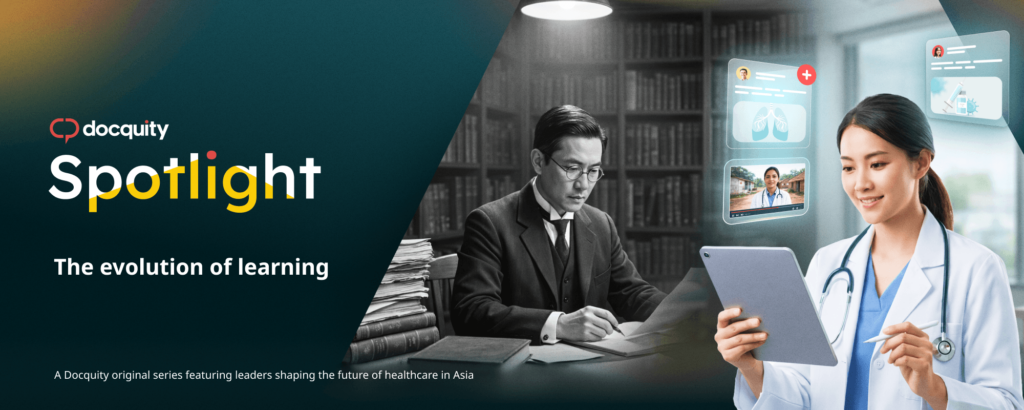
Dr. Joselyn Eusebio on staying connected while keeping care human in the digital era
Medicine evolves constantly, so doctors must too. In this edition of Docquity Spotlight, we speak to Dr. Joselyn Eusebio (Dr. Josie), President of the Asia Pacific Pediatric Association (APPA), about how the digital era is reshaping lifelong learning.
With over three decades of experience as a clinician and educator in pediatric care in the Philippines, Dr. Josie discusses how today’s doctors must increasingly apply digital learning in practice and yet maintain human judgment in a connected healthcare world.

Q: You’ve been both a clinician and an educator for decades. How has the idea of “continuous learning” evolved since you began your medical career?
A: When I began my career, continuous learning was primarily confined to textbooks, journals and physical conferences, a relatively slow, often isolated process. Today, it has undergone a digital revolution. It’s no longer just about absorbing information; it’s about real-time knowledge synthesis and global collaboration. The expectation has shifted from simply keeping up to being instantly connected to the latest research and best practices from around the world. It’s now a dynamic, always-on engagement with the global medical community, making learning much faster and more accessible.
“The expectation has shifted from simply keeping up to being instantly connected to the latest research and best practices from around the world.”
Q: Why is it so vital for doctors today to adopt a mindset of lifelong learning?
A: The sheer pace of medical innovation makes lifelong learning non-negotiable. Treatments, diagnostic tools and public health challenges evolve faster than ever before. If a doctor stops learning, their practice becomes outdated almost immediately, leading to suboptimal patient outcomes. Furthermore, a commitment to lifelong learning fosters professional resilience and adaptability. It ensures we maintain competence, ethical grounding and confidence in our rapidly changing field, ultimately upholding our oath to provide the best possible care throughout a patient’s life.
Q: How has technology changed the way doctors learn and share knowledge?
A: Technology has transformed learning from a passive reception into an active, immediate and democratic experience. We moved from waiting months for a journal issue to accessing curated, peer-reviewed content instantly. Sharing knowledge is now real-time and global thanks to online forums and communities, such as Docquity. Technology facilitates inter-specialty collaboration across borders, breaking down geographical barriers. It has enabled features like case-based discussions with international experts and access to surgical videos, allowing us to learn, teach and consult on complex patient cases with unprecedented efficiency.
Q: Are there any types of tools you’ve found particularly helpful in your own learning and teaching journey?
A: I gravitate toward tools that offer curation, collaboration and practical application. Specifically, platforms that provide short, impactful summaries of new research, enabling me to quickly filter relevant information. I also value digital spaces that facilitate interactive, asynchronous discussions with peers globally. For teaching, tools that allow me to create and share rich media, like clinical case simulations or procedural videos, are essential. The best tools bridge the gap between abstract knowledge and real-world clinical utility.
Q: As technology becomes more central to healthcare and education, where do you think technology should help, and where must empathy still lead?
A: Technology is a powerful enabler; it should help in areas requiring speed, precision and data processing. This includes diagnostics, surgical planning, literature review and automating administrative tasks. However, empathy must always lead in patient-physician relationships. Technology should never replace the human element of medicine, the ability to listen, reassure, connect and provide comfort. Empathy is the foundation of trust, ethical decision-making and holistic care. Technology optimizes the science of medicine, but empathy defines the art.
“Technology should never replace the human element of medicine, the ability to listen, reassure, connect and provide comfort.”
Q: What advice would you give to younger doctors starting their own learning journeys in today’s connected world?
A: My main advice is to treat your learning journey as a personalized, structured curriculum, not just a random feed of information. Be a critical filter. Don’t just consume the vast content available online, instead seek out peer-reviewed, high-quality sources. Embrace digital tools for efficiency and networking but never neglect fundamental patient interaction and clinical reasoning. Most importantly, find a mentor online or in person. Technology connects you to data, but a mentor connects you to wisdom and the humanity of medical practice.
As healthcare becomes more connected, Dr. Josie’s insights underscore the role of trusted professional communities in supporting how doctors learn, share and grow. Technology accelerates access to knowledge, while human judgment continues to shape how that knowledge is applied in patient care – a balance that remains central to continuous learning in the digital era.
This conversation is part of Docquity Spotlight, Docquity’s thought leadership series featuring industry experts sharing perspectives on the future of healthcare across Asia.